A front door that refuses to close properly can be surprisingly frustrating. You push it, pull it, lift the handle and try again. Eventually, it might shut—but something clearly isn’t working as it should.
Perhaps your uPVC door catches against the frame. Maybe the locking mechanism only works when you pull the door towards you. Or perhaps a wooden door has suddenly started sticking after a spell of wet weather.
Whatever the symptoms, a door that doesn’t close correctly is more than an everyday inconvenience. It can place unnecessary stress on locks and hinges, affect weatherproofing and, in some circumstances, compromise home security.
The good news is that many door problems have identifiable causes. Some involve straightforward adjustments, while others require attention to the hinges, frame, locking mechanism or door itself.
If your entrance can no longer be secured, an experienced Emergency locksmith Enfield can assess the door and locking arrangement to determine what needs repairing.
Let’s explore the most common questions homeowners ask when their doors stop behaving normally.
📑 Table of Contents
🚪 Why Has My Door Suddenly Stopped Closing Properly?
🔍 How Can I Tell Whether My Door Is Misaligned?
⚙️ Why Does My uPVC Door Need Lifting to Lock?
🌧️ Can Weather Affect How My Door Closes?
🔐 Why Does My Lock Work When the Door Is Open?
🔩 Could Loose Hinges Be Causing the Problem?
🚪 Why Does My Door Catch Against the Frame?
🔑 Can a Faulty Lock Stop a Door Closing?
🛠️ Should I Repair or Replace a Problem Door?
📊 Common Door Problems and Possible Causes
🛡️ How Can I Prevent Door Problems?
❓ Frequently Asked Questions
✅ Final Thoughts
🚪 Why Has My Door Suddenly Stopped Closing Properly?
A door that previously operated smoothly can begin causing problems for several reasons.
The most common possibilities involve changes to the relationship between the door, frame, hinges and locking mechanism.
For example:
🔩 Hinge movement — Worn or loose hinges may allow the door to drop slightly.
🚪 Door misalignment — The door may no longer sit correctly within its frame.
🌧️ Weather-related movement — Temperature and moisture changes can affect certain door materials.
⚙️ Locking mechanism problems — Components may become worn, damaged or difficult to engage.
🪵 Frame movement — Changes to the surrounding frame can interfere with normal operation.
🔐 Latch or keep alignment — The latch may no longer meet its corresponding opening correctly.
Sometimes several small issues contribute to the same symptom.
For that reason, replacing the lock immediately isn’t always the correct solution. The complete door assembly needs to be considered.
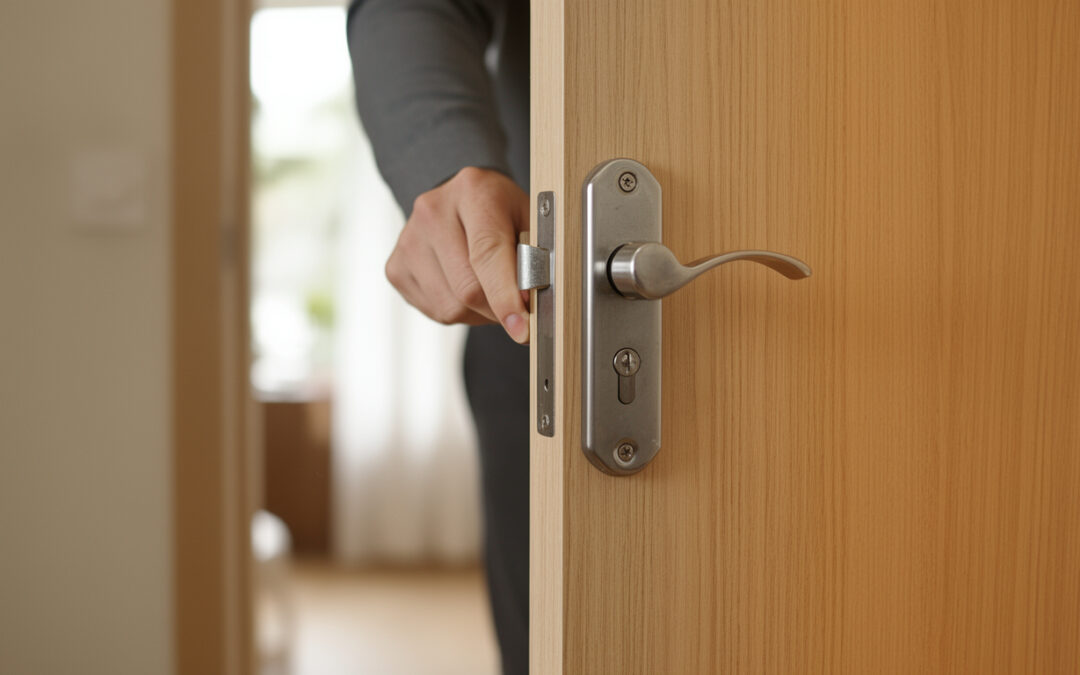
📸 Image: Homeowner Struggling to Close a Front Door
A realistic British residential scene showing a homeowner gently attempting to close a modern front door that is catching against its frame. The image should clearly communicate a common alignment problem without showing excessive force or unsafe repairs. Natural daylight, professional editorial photography and subtle #7EBEC5 accents.
🔍 How Can I Tell Whether My Door Is Misaligned?
Door misalignment occurs when the door no longer sits or operates correctly in relation to its frame.
You might notice that:
🚪 The door catches at the top or bottom.
🔐 The latch doesn’t engage smoothly.
⬆️ You need to lift the handle or door unusually hard.
⬅️ You must pull the door towards you before locking it.
🔑 The key becomes difficult to turn once the door is closed.
👀 The gap between the door and frame appears uneven.
These symptoms don’t automatically confirm misalignment, but they provide useful clues.
🛠️ A Simple Observation
With the door open, carefully operate the handle and locking mechanism as intended.
Then compare how the mechanism behaves when the door is closed.
If everything moves smoothly while open but becomes noticeably harder when closed, alignment or engagement with the frame may be contributing to the problem.
Don’t force the mechanism if it resists. Continued pressure can place unnecessary stress on the locking components.
⚙️ Why Does My uPVC Door Need Lifting to Lock?
Many uPVC and composite doors use multipoint locking systems.
These mechanisms engage several locking points along the edge of the door. On many designs, lifting the handle is a normal part of the locking process.
However, there’s an important distinction between lifting the handle as designed and having to apply unusual force.
If your handle has become progressively harder to lift, possible causes include:
⚙️ Worn multipoint locking components
🚪 Poor door alignment
🔩 Hinge movement
🔐 Locking points failing to engage correctly
🛠️ Problems with associated door hardware
A multipoint mechanism relies on the door and frame being correctly positioned.
If the locking points no longer line up with their corresponding keeps, the handle may become difficult to operate.
The solution might involve adjustment, repair or replacement of a particular component—not necessarily the entire locking system.
🌧️ Can Weather Affect How My Door Closes?
Yes. Weather conditions can influence how some doors and frames behave.
However, the effect depends on the material, construction and condition of the door.
🪵 Wooden Doors
Timber responds to changes in moisture.
During damp conditions, some wooden doors may absorb moisture and expand, causing them to stick against the frame.
Changes in humidity can also affect the way timber doors fit over time.
🚪 uPVC Doors
uPVC components can expand and contract as temperatures change.
Where tolerances are already tight or the door is slightly misaligned, temperature-related movement may make an existing problem more noticeable.
🛡️ Composite Doors
Composite doors contain several materials, and their response to environmental conditions depends on their construction.
Installation quality, alignment and hardware condition remain important.
🛠️ The Easy Fix
Avoid immediately cutting, planing or forcing a door simply because it becomes difficult during particular weather conditions.
First establish whether the problem is temporary movement, existing misalignment or deterioration elsewhere in the assembly.
🔐 Why Does My Lock Work When the Door Is Open but Not Closed?
This is one of the most useful clues when investigating door problems.
When the door is open, the locking mechanism may operate without interference from the frame.
Once the door closes, the latch, bolts or multipoint locking components must engage with their corresponding openings.
If those components aren’t correctly aligned, resistance can develop.
🔍 Possible Causes
🚪 The door has dropped slightly.
🔩 Hinges have moved or deteriorated.
⚙️ Locking points no longer align correctly.
🪵 The frame has shifted or become distorted.
🔐 A keep or strike plate is incorrectly positioned.
A locksmith can assess whether the problem lies with the door’s positioning or the mechanism itself.
An Emergency locksmith Enfield may be needed when the fault has progressed to the point that your entrance cannot be locked securely.
🔩 Could Loose Hinges Be Causing the Problem?
Absolutely.
Hinges support the weight of the door and help maintain its position within the frame.
Over time, hinges or their fixings may loosen or wear.
Depending on the door design, this can cause:
⬇️ The door to drop.
🚪 Uneven gaps around the frame.
⚙️ Locking points to become misaligned.
🔐 The latch to miss its intended opening.
🔊 Rubbing, scraping or unusual noises.
🛠️ What Should You Do?
Look for obvious signs of looseness, damage or movement.
However, avoid making random hinge adjustments without understanding the specific hinge system.
Some uPVC hinges provide adjustment in multiple directions, and incorrect adjustments can make the original problem worse.
Where hinges are damaged or the door has become difficult to secure, professional inspection is advisable.
🚪 Why Does My Door Catch Against the Frame?
A door that rubs or catches against the frame may be suffering from misalignment, material movement or physical deterioration.
The location of the contact can provide clues.
⬆️ Catching at the Top
Possible causes include changes in alignment, hinge positioning or frame condition.
⬇️ Catching at the Bottom
The door may have dropped, the threshold may be interfering or another component may have moved.
↔️ Catching Along the Side
This can occur when the door and frame no longer sit correctly in relation to one another.
🔐 Catching Near the Lock
The latch, keep or locking mechanism may be contributing to the problem.
These are possibilities rather than definitive diagnoses.
A door can catch in one location while the underlying cause originates somewhere else.
🔑 Can a Faulty Lock Stop a Door Closing?
Yes, although the symptoms can vary.
A damaged or incorrectly operating latch may interfere with normal closing.
Problems elsewhere in a multipoint mechanism can also prevent components from retracting or engaging as intended.
Watch for:
⚠️ A latch that doesn’t retract normally.
⚙️ Locking components that remain extended unexpectedly.
🔑 A key that becomes difficult to turn.
🔐 A mechanism that jams intermittently.
🚪 A door that cannot be closed or secured reliably.
If the mechanism is visibly damaged or refuses to operate normally, avoid repeatedly forcing the door shut.
Doing so could damage additional components.
🛠️ Should I Repair or Replace a Problem Door?
Not every troublesome door needs replacing.
In many cases, the appropriate solution involves addressing a particular fault.
🔧 Repair or Adjustment May Be Suitable When:
✅ The door itself remains structurally sound.
✅ Hinges require appropriate adjustment or repair.
✅ The locking mechanism can be repaired economically.
✅ A latch or keep needs professional attention.
✅ The issue involves correctable alignment.
🚪 Replacement May Be Worth Considering When:
⚠️ The door or frame is significantly damaged.
⚠️ Structural deterioration affects security.
⚠️ Repeated repairs have become uneconomical.
⚠️ The existing installation is no longer suitable.
⚠️ A broader security or performance upgrade is required.
The important thing is to identify the cause before deciding how much work is necessary.
Replacing an otherwise serviceable door because of a correctable hinge or alignment issue may be unnecessary.
Equally, repeated adjustments won’t necessarily solve a door that has suffered serious structural damage.
🛡️ How Can I Prevent Door Problems?
Not every door fault can be prevented, but regular observation and appropriate maintenance can help identify developing problems.
👀 1. Notice Changes Early
Pay attention when a door becomes harder to close or lock.
A gradual change is still worth investigating.
🔩 2. Check Visible Hardware
Look for loose handles, damaged hinges and other obvious signs of deterioration.
🚪 3. Avoid Slamming Doors
Repeated heavy impacts can place unnecessary stress on door hardware and frames.
🔑 4. Don’t Force the Key
If turning the key requires increasing effort, find out why rather than applying more pressure.
🌧️ 5. Maintain Suitable Weather Protection
Keep seals and surrounding components in appropriate condition, following manufacturer guidance where available.
⚙️ 6. Follow Recommended Maintenance
Different doors, hinges and locks may have specific maintenance requirements.
Avoid applying unsuitable lubricants or making adjustments without understanding the mechanism.
🔐 7. Arrange Repairs Before Complete Failure
If the door is becoming progressively harder to secure, don’t wait until it stops working entirely.
📉 From a Sticking Door to a Reliable Entrance
🚪 DOOR BECOMES DIFFICULT TO CLOSE
⬇️
👀 IDENTIFY THE SYMPTOMS
⬇️
🔍 CHECK FOR VISIBLE DAMAGE
⬇️
⚙️ OBSERVE LOCK OPERATION
⬇️
🔩 CONSIDER HINGES AND ALIGNMENT
⬇️
🚫 AVOID FORCING THE DOOR
⬇️
🛠️ IDENTIFY THE ACTUAL FAULT
⬇️
🔧 ADJUST • ⚙️ REPAIR • 🚪 REPLACE IF NECESSARY
⬇️
🛡️ RESTORE RELIABLE DOOR SECURITY
🚨 When Does a Door Problem Become an Emergency?
A door that catches slightly may be inconvenient, but it doesn’t always require urgent assistance.
The situation changes when the problem affects your ability to enter, leave or secure the property.
Examples include:
🔐 The door won’t lock — Your home may be left insecure.
🚪 The door won’t open — Access or safe escape may be affected.
⚙️ The mechanism has jammed — Normal operation may no longer be possible.
🔑 The key has broken inside the lock — Access or security may be compromised.
🔩 A hinge or fitting has failed — The door may no longer be safely supported.
🚨 The door has suffered attempted forced entry — Damage may affect the security of the entrance.
Where a door is part of an emergency escape route, problems that prevent safe opening deserve particularly prompt attention.
If someone is trapped or there is an immediate danger, contact the appropriate emergency services.
For urgent locking or security problems, an Emergency locksmith Enfield can assess the affected entrance and advise on the work needed to restore secure operation.
❓ Frequently Asked Questions About Doors That Won’t Close
Why do I have to lift my front door to lock it?
If you’re physically lifting or pulling the door beyond its normal operating procedure, misalignment or hinge movement may be involved.
However, lifting the handle is normal for many multipoint locking systems. The concern is unusual resistance or a change from how the door previously operated.
Can a uPVC door be adjusted without replacing it?
Often, yes. Many uPVC doors have adjustable hinges or other components.
Whether adjustment will solve the problem depends on the condition of the door, frame and locking system.
Why does my wooden door stick when it rains?
Timber can absorb moisture and expand, potentially affecting the fit between the door and frame.
Persistent problems should be assessed before material is removed or significant alterations are made.
Is it dangerous to keep forcing a stiff door lock?
Continually applying excessive force can damage keys, handles or locking components.
If the mechanism has become unusually difficult to operate, investigate the cause.
Can a misaligned door damage the lock?
Yes. When locking components don’t engage correctly, repeated operation under resistance can place additional stress on the mechanism.
Should I replace the lock if the door won’t close?
Not automatically. The problem may involve hinges, alignment, the latch or the frame rather than the lock itself.
How do I know whether the frame is causing the problem?
Uneven gaps, visible movement, damage or difficulty engaging the latch may provide clues.
However, a complete inspection may be needed to distinguish frame problems from door or hardware faults.
Can I fix a sticking door myself?
Basic observations and cleaning around accessible external surfaces may be reasonable.
However, avoid dismantling locks, altering security fittings or making unfamiliar hinge adjustments. Incorrect work can worsen the problem or affect security.
💷 Why Early Attention Can Help Avoid Larger Repairs
Door problems often develop gradually.
At first, you notice a little resistance.
Then you start pulling the door towards you.
Eventually, the handle needs more force, or the key becomes difficult to turn.
By the time the mechanism stops operating altogether, the problem may be considerably less convenient.
Early attention can help because it allows the underlying issue to be identified before repeated force causes additional wear.
For example, correcting a suitable alignment problem may prevent unnecessary stress on an otherwise serviceable multipoint locking mechanism.
This doesn’t guarantee that every repair will be inexpensive, but it gives you a better opportunity to address the problem before it becomes an emergency.
🏡 Remember: Your Door Is a Complete Security System
It’s tempting to focus entirely on the lock whenever a door becomes troublesome.
However, a secure and reliable entrance depends on several components working together.
🚪 Door — Must remain sound and correctly positioned.
🪵 Frame — Must provide suitable support and alignment.
🔩 Hinges — Must support the door and allow smooth movement.
⚙️ Locking mechanism — Must engage and disengage correctly.
🔐 Cylinder — Must provide reliable key operation.
🛡️ Fittings and keeps — Must remain secure and correctly positioned.
A problem with one component can affect the operation of the others.
That’s why diagnosing the complete assembly is often more useful than replacing the first part that appears troublesome.
🔧 When Should You Contact Unique Locksmiths?
If your door has become increasingly difficult to close, lock or open, professional assessment may help identify the problem before further damage develops.
Unique Locksmiths can assist with evaluating common door and locking issues, including problems involving:
🚪 Door alignment
🔩 Hinges and associated fittings
⚙️ Multipoint locking mechanisms
🔐 Faulty or unreliable locks
🔑 Damaged or broken keys
🛠️ Door hardware requiring repair or replacement
For homeowners dealing with an entrance that can no longer be secured, seeking prompt professional assistance is particularly important.
Before agreeing to work, ask for an explanation of the suspected fault, proposed repair and expected charges.
✅ Final Thoughts
A door that won’t close properly shouldn’t automatically be treated as a minor inconvenience—or as proof that the entire door needs replacing.
Sometimes the problem involves hinge movement. In other cases, weather-related changes, poor alignment, damaged hardware or a faulty locking mechanism may be responsible.
The most useful approach is to recognise the symptoms, avoid excessive force and identify the actual cause before deciding on a repair.
If your door has started catching, your handle has become difficult to operate or your lock only works when the door is open, don’t simply adapt to the problem.
Unique Locksmiths can help homeowners investigate troublesome doors and locking systems, determine whether adjustment or repair is appropriate and identify when replacement is necessary.
If the problem has left your property insecure, an Emergency locksmith Enfield can provide professional assistance with the affected door or lock.
A door should close smoothly, lock reliably and protect your home without requiring a special technique every time you use it.